How Elixir Powers AI Agents to Transform Healthcare

Elixir powers AI agents that are already changing how U.S. healthcare organizations operate, from cutting clinician documentation time by up to 40% to enabling real-time patient monitoring across thousands of concurrent sessions.
Elixir’s OTP-based, fault-tolerant architecture suits medical AI’s needs: high availability, persistent state, and safe integration with standards like FHIR and ICD-10. For healthcare AI infrastructure, Elixir is increasingly the backbone of reliable, production-grade systems.
Unlike older healthcare digital systems, this new era has smart AI agents that can act, think, and work together. They can schedule follow-ups, identify patients, write notes, and handle authorizations automatically. They do not need to be told what to do each time. Elixir’s separate OTP processes make sure that if one agent fails, the whole system keeps working. This meets important healthcare reliability rules.
Below, we explore how Elixir-built AI agents improve outcomes, expand provider tools, reshape care, and detail the technical architecture in practice.
How Elixir-powered AI agents improve patient outcomes
The biggest benefit of Elixir-powered AI agents for patients is the move from reactive to predictive care. Instead of waiting for a patient to get worse, these agents watch data all the time. They check information from wearables, health records, or lab tests and find signs of risk early. This constant monitoring is only possible if the system can handle many patients at once without slowing down. Elixir’s BEAM virtual machine is made for this kind of work.
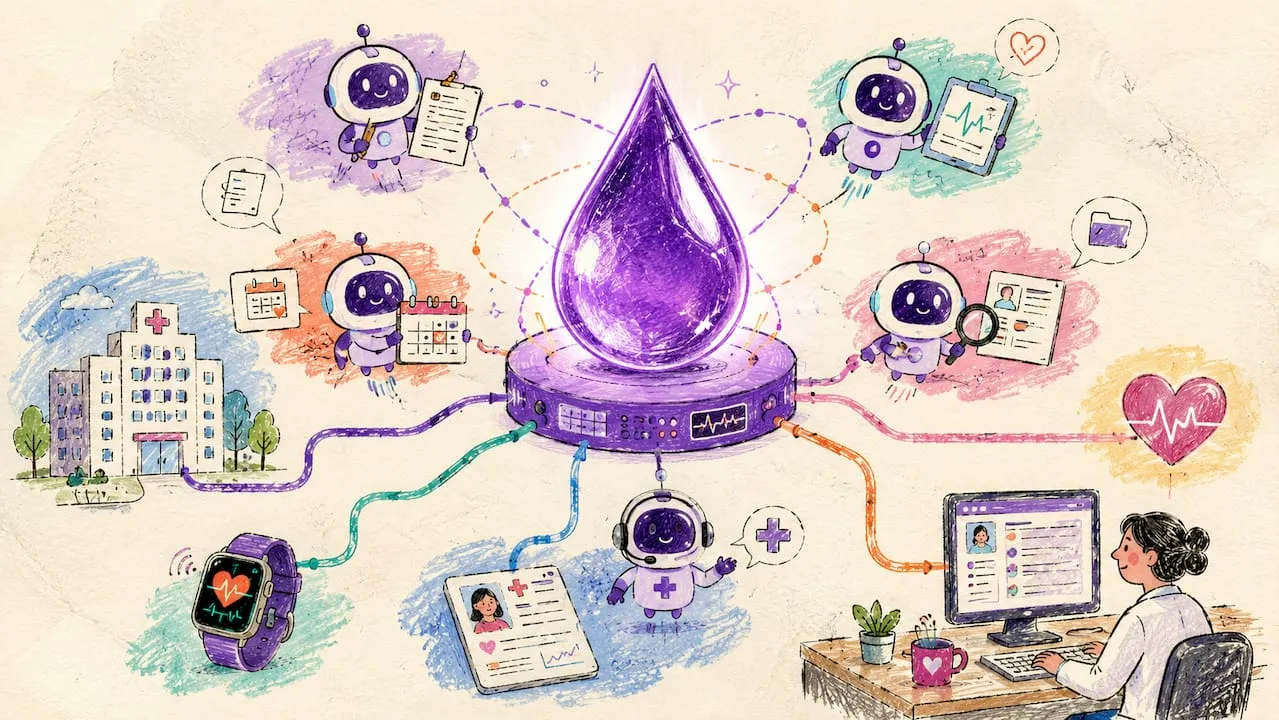
Personalized treatment plans are a key benefit. Multi-modal data integration—combining genomic, clinical, and demographic data—distinguishes true personalized care from generic protocols. AI agents built on Elixir analyze these streams in real time, providing recommendations tailored to each patient. This allows care to adapt as the patient’s condition changes, not just at scheduled visits.
Patient engagement improves when the agent remembers context. A stateless REST system resets each request, forcing patients to re-explain. Elixir’s GenServer retains full context throughout an encounter, making interactions coherent and reducing disengagement.
Key patient-centered benefits delivered by Elixir AI agents:
- Proactive complication prediction based on continuous monitoring of vitals and lab trends, reducing preventable readmissions
- Personalized medication and care plan adjustments driven by real-time multi-modal data analysis
- 24/7 accessible care guidance through AI agents that maintain context across sessions, improving adherence to treatment plans
- Faster triage and routing that connects patients to the right level of care without unnecessary delays
- Reduced care gaps through automated follow-up scheduling and proactive outreach to at-risk populations
Stat to know: AI-assisted documentation using voice-to-text and summarization reduces clinician burden by up to 70%, freeing providers to spend more time on direct patient interaction rather than administrative tasks.
What Elixir AI agents add to the provider’s toolkit
Clinician burnout in U.S. healthcare often stems from documentation, which takes hours away from patient care. AI platforms built on Elixir cut documentation and chart review time reliably at scale.
Elixir AI tools go beyond note-taking. A clinical resource assistant can track a patient’s history, medications, and alerts, providing relevant info during a consult. Diagnostic agents compare symptoms to guidelines and highlight potential diagnoses, even under time pressure. These proven capabilities are implemented in real healthcare systems with high reliability.
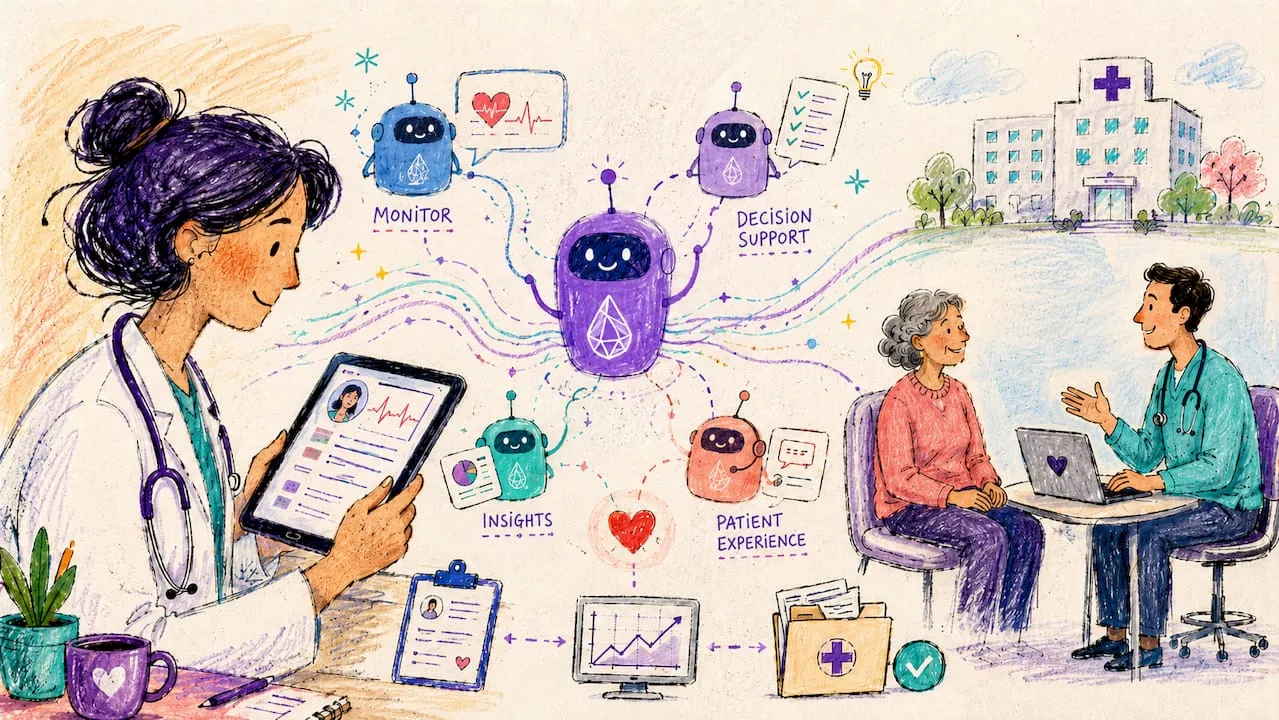
Autonomous documentation agents automate clinical workflows end-to-end while keeping a human clinician in the loop for final review and sign-off. This hybrid model, where the agent handles the mechanical work and the clinician handles judgment, is how you get the efficiency gains without sacrificing clinical governance. Elixir’s process isolation means each patient’s documentation agent runs independently, so a problem with one patient’s workflow never touches another’s.
Provider tool capabilities that Elixir AI agents unlock:
- Ambient clinical documentation that listens to patient-provider conversations and generates structured EHR notes in real time
- Diagnostic decision support that surfaces evidence-based differential diagnoses and treatment options during the encounter
- Prior authorization automation that prepares and submits requests based on clinical data already in the EHR
- Clinical resource assistants that maintain full patient context across long interactions, reducing cognitive load on providers
- Automated care gap alerts that notify providers of overdue screenings, vaccinations, or follow-ups before the patient visit
Pro Tip: When building clinical AI agents with Elixir, model each patient session as a dedicated GenServer to ensure concurrency, fault isolation, and easy supervision. If a session crashes, the supervisor restarts it without affecting others, meeting HIPAA requirements.
Many healthcare AI projects get stuck on EHR integration. Elixir’s pattern matching makes it easier to read HL7 and FHIR messages. It turns messy data into correct records for other systems. Its features for AI rules and compliance help put agents into current clinical setups.
How Elixir AI agents reshape the healthcare ecosystem
The use of AI agents built with Elixir affects more than just individual patient visits or how providers work. On a larger scale, these agents help different groups work together. They connect doctors, insurance companies, pharmacies, and public health systems in ways that were too difficult or slow before. It’s not just adding a new tool, but changing how information and decisions move across the whole healthcare system.
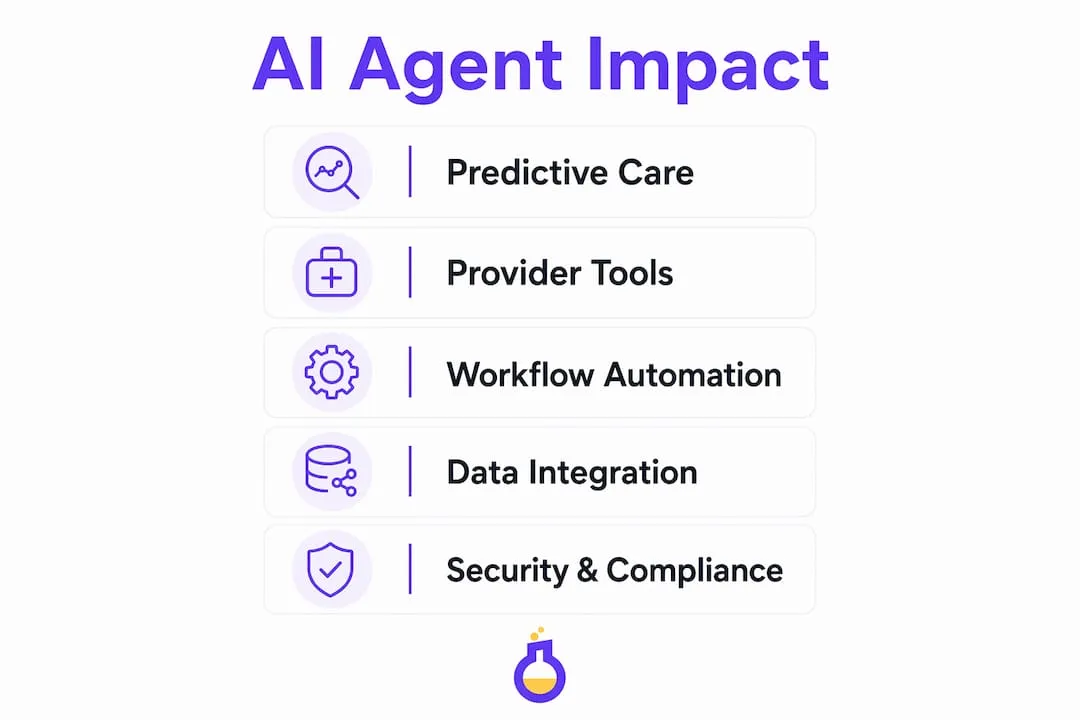
Claims processing shows this well. An Elixir multiagent system can autonomously manage the entire prior authorization and claims adjudication pipeline—fetching clinical data, matching payer criteria, flagging exceptions, and submitting claims—within one workflow. Elixir’s distributed architecture ensures each step runs as a supervised process. If the payer API fails, agents pause and retry without disrupting the process.
Healthcare AI agents that automate clinical workflows with human oversight exemplify responsible ecosystem transformation. The aim is to reduce administrative friction for clinicians, not remove them. Elixir’s architecture makes it easy to add human-in-the-loop checkpoints at any stage without system overhaul.
Ecosystem transformation benefits enabled by Elixir AI agents:
- Automated claims and prior authorization pipelines that reduce administrative overhead and accelerate reimbursement cycles
- Coordinated care transitions where agents share patient context across provider handoffs, reducing gaps and duplicated tests
- Compliance monitoring that continuously checks clinical and billing activity against regulatory requirements, surfacing issues before they become violations
- Population health management through agents that aggregate and analyze data across patient cohorts to identify systemic risk patterns
- Reduced care fragmentation by enabling real-time data sharing between previously siloed systems, including legacy EHRs and payer platforms
Integrating with legacy healthcare standards is vital. FHIR and ICD-10 are key U.S. healthcare data languages, and AI must speak them fluently. Elixir’s pattern matching converts LLM outputs into structured, standards-compliant records, reducing manual cleanup. This ensures AI healthcare projects reach production.
Building Elixir AI agents for healthcare: architecture, security, and adoption
The OTP concurrency model as healthcare infrastructure
Elixir’s OTP actor model enables HIPAA-compliant, high-availability healthcare platforms without costly infrastructure. Each AI agent runs as a lightweight OTP process, isolated on the BEAM. Crashes don’t spread; supervisors restart failed processes in milliseconds, keeping patient sessions uninterrupted.
Compare this to thread-based concurrency models, where shared state and locking create both performance bottlenecks and hard-to-audit data access patterns. In a regulated environment where you need to demonstrate that patient A’s data never touched patient B’s session, Elixir’s process isolation gives you that guarantee structurally, not just by policy.
Stateful agents with GenServers
The practical architecture for a healthcare AI agent in Elixir centers on GenServer processes that carry the full state of a clinical session. Here is a minimal example of what that looks like:
defmodule HealthcareAgent do
  use GenServer

  def start_link(patient_id) do
    GenServer.start_link(__MODULE__, %{patient_id: patient_id, context: []}, name: via(patient_id))
  end

  def init(state), do: {:ok, state}

  def handle_call({:add_context, entry}, _from, state) do
    updated = Map.update!(state, :context, &[entry | &1])
    {:reply, :ok, updated}
  end

  def handle_call(:get_context, _from, state) do
    {:reply, state.context, state}
  end

  defp via(patient_id), do: {:via, Registry, {AgentRegistry, patient_id}}
end
This pattern provides each patient with a dedicated process storing their full interaction history, flags, and pending actions. When the agent calls an LLM for diagnosis, it passes the entire context, not just the last message. This ensures a coherent conversation that stateless microservices can’t replicate.
How Elixir compares to other languages in healthcare AI
Most healthcare AI projects favor Python for its machine learning ecosystem and data science pipelines. Elixir excels in agent orchestration—managing sessions, handling failures, integrating with EHR APIs, and scaling in production. Python’s GIL and threading hinder this layer. Node.js manages concurrency better but lacks Elixir’s supervision trees and fault isolation via OTP.
The practical pattern we recommend is a hybrid: Python or a managed LLM API for inference, Elixir for agent orchestration, session management, EHR integration, and the human-in-the-loop governance layer. This gives you the best of both ecosystems without forcing either into a role it was not designed for. Elixir’s strengths for AI applications in this orchestration role are well-documented, and the pattern is production-proven.
| Capability | Elixir (OTP) | Python async | Node.js |
|---|---|---|---|
| Concurrent patient sessions | Thousands, isolated per process | Limited by GIL and thread overhead | Good, but no supervision trees |
| Fault isolation | Structural, per-process | Manual, requires extra tooling | Manual, limited native support |
| Stateful session management | Native via GenServer | Requires external state store | Requires external state store |
| FHIR/HL7 data transformation | Pattern matching, clean and typed | Possible, verbose | Possible, verbose |
| Supervision and auto-restart | Built into OTP | External orchestration needed | External orchestration needed |
| HIPAA audit trail support | Process-level isolation aids compliance | Requires additional architecture | Requires additional architecture |
Security, privacy, and human-in-the-loop governance
Hybrid AI with human oversight ensures safe, compliant clinical workflows. In Elixir, this is done by adding approval steps to the agent’s state machine. The agent can gather data, generate recommendations, and prepare notes autonomously, but final EHR updates occur only after clinician confirmation, which is just another message in the mailbox, keeping the architecture clean and auditable.
HIPAA compliance benefits from process isolation: each patient’s agent is a separate process, so access logs and audits are naturally scoped. This avoids filtering shared logs. Encryption, role-based access, and BAA agreements are still needed, but Elixir’s architecture simplifies compliance and auditing.
Pro Tip: Use Elixir’s AI agent architecture pattern of pairing each GenServer with a dedicated audit log process under the same supervision tree. When the agent process restarts after a failure, the audit log process survives independently, preserving the full event history for compliance review.
Best practices for adopting Elixir in healthcare AI projects:
- Start with the orchestration layer. Replace your session management and EHR integration layer with Elixir first, before touching inference pipelines.
- Model each patient session as an OTP process. This gives you fault isolation, state persistence, and supervision for free.
- Use Elixir’s pattern matching for FHIR parsing. It handles the structural complexity of clinical data formats cleanly and produces typed, validated outputs.
- Design human-in-the-loop checkpoints as explicit state transitions. Do not bolt approval steps on as an afterthought; build them into the agent’s state machine from the start.
- Pair each agent process with a supervised audit log process. This keeps your compliance trail intact even when individual agents restart.
- Test supervision trees under failure conditions before go-live. Kill processes deliberately in staging and verify that the supervisor restarts them correctly and that no patient data is lost or corrupted.
For teams exploring healthcare AI automation at the infrastructure level, Elixir’s OTP model provides the kind of structural guarantees that make the difference between a demo and a production system.
Key Takeaways
Elixir’s OTP concurrency model is the most practical foundation available today for building AI agents that meet healthcare’s availability, compliance, and scale requirements simultaneously.
| Point | Details |
|---|---|
| Documentation burden reduction | AI-assisted documentation reduces clinician burden by up to 70%, freeing providers for direct patient care. |
| Concurrent session handling | Elixir’s BEAM runtime manages thousands of isolated patient AI agent sessions without cascading failures. |
| Stateful clinical context | GenServer processes retain full patient context across long encounters, outperforming stateless microservice approaches. |
| Ecosystem integration | Elixir’s pattern matching transforms LLM outputs into FHIR- and ICD-10-compliant records, reducing clinical data errors. |
| Human-in-the-loop governance | Hybrid AI models with clinician oversight maintain safety and regulatory compliance in clinical decision workflows. |
Ready to build healthcare AI agents with Elixir?
At Elixirator, we develop reliable AI systems in Elixir for healthcare. Our team has experience with OTP agents, EHRs, and regulations. If you’re considering Elixir for a healthcare AI project or want to improve your current system, we’d love to discuss how we can help.
Explore our Elixir AI development services or take a closer look at our AI and LLM development practice to see how we approach these projects in practice. When the stakes are clinical, the architecture has to be right from the start.