AI Agents and Elixir in EnergyTech
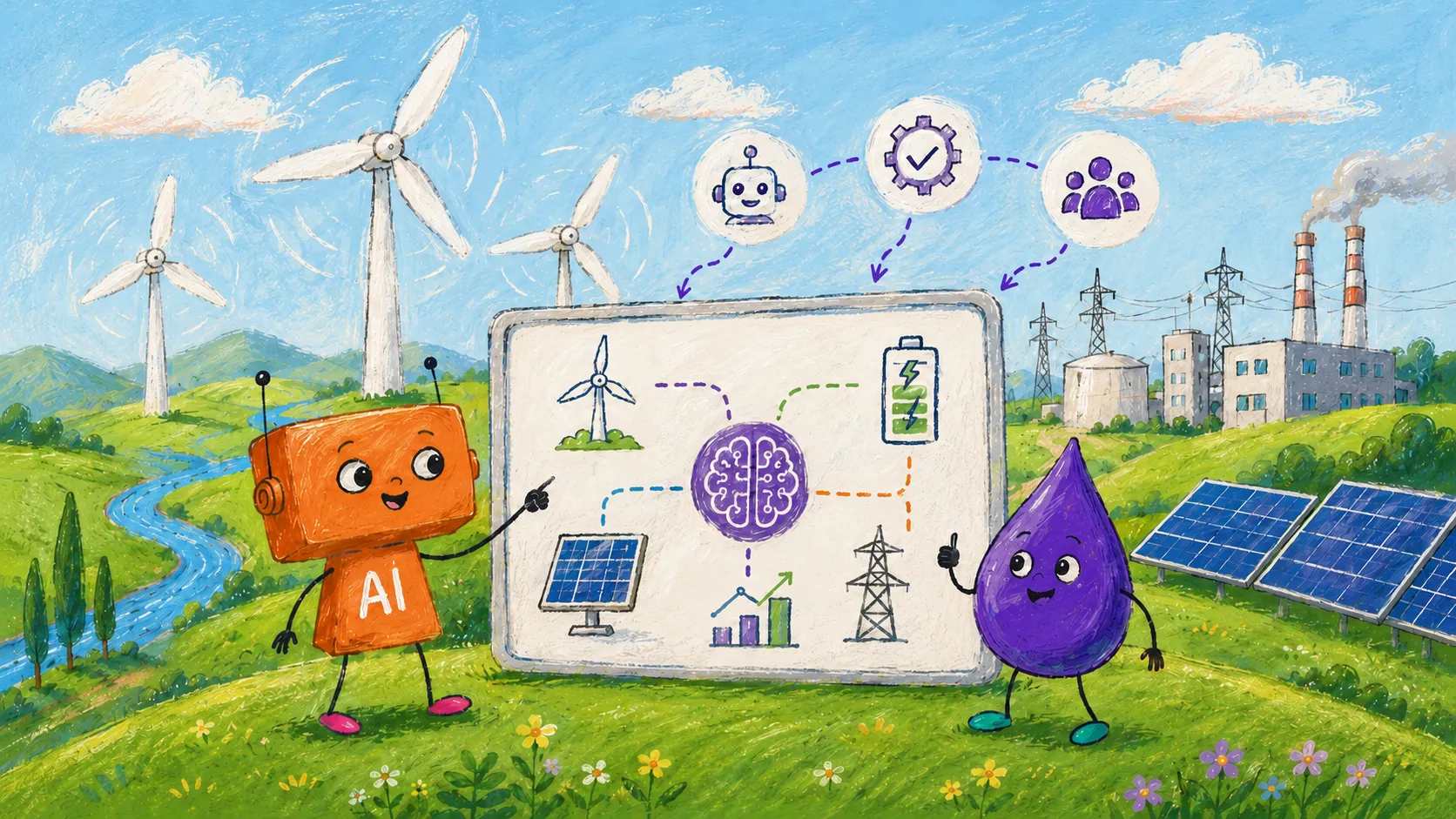
Building scalable AI for energy systems isn’t just an intelligence problem—it’s an orchestration problem. AI models can predict demand and spot grid anomalies, but they need a bulletproof environment to run continuously without dropping the ball. That’s where Elixir comes in. Leaving heavy math and inference to Python, Elixir leverages the BEAM runtime to manage thousands of concurrent, autonomous agents with zero single points of failure. By natively handling retries, state management, and real-time data flows, Elixir has quickly established itself as the gold standard runtime for fault-tolerant AI agent architectures in EnergyTech.
Why this is a game-changer for EnergyTech:
- AI agents are autonomous, stateful software processes that perceive inputs, reason over them, and take actions, often in loops that run for hours or days.
- Elixir’s BEAM runtime spawns millions of lightweight processes, each isolated, each supervised, making it a natural fit for running thousands of concurrent agents.
- Fault tolerance by design means a crashed agent restarts without cascading failures across the system.
- Libraries like Jido, ElixirLLM, and ClaudeCode give you production-ready tooling for LLM routing, reasoning strategies, and OTP-native session management.
- EnergyTech demands grid stability, real-time responsiveness, and zero-downtime operation, all of which align directly with what BEAM was built for.
Table of contents
- How AI agents and Elixir work together in EnergyTech
- Architectural patterns that hold up under real EnergyTech load
- How Elixir compares to Python and other runtimes for agent orchestration
- EnergyTech-specific challenges and how Elixir addresses them
- Architectural best practices
- Specific use cases where Elixir AI agents deliver in EnergyTech
- Elixirator builds the Elixir AI layer your energy platform needs
- Key takeaways
How AI agents and Elixir work together in EnergyTech
The BEAM VM treats each process as a first-class citizen with its own heap, mailbox, and lifecycle. Mapping AI agents to GenServers provides automatic failure isolation: one agent crashing doesn’t affect others. This is the default in Elixir, not an extra design.
It’s especially beneficial for long-running workflows. An agent monitoring grid frequency, calling an LLM for analysis, and dispatching commands can run days. Elixir’s supervision tree keeps it alive, restarts on failure, and allows state inspection without stopping the system.
ElixirLLM offers unified access to major LLMs like GPT and Claude, while Jido adds eight reasoning strategies, from ReAct for tool-calling to Chain-of-Thought for multi-step analysis. They enable defining agents as Elixir modules and running requests with retries and telemetry.
A strong production example is Reel, a Copenhagen-based EnergyTech company that supplies and trades electricity while helping businesses and renewable-energy producers manage price volatility, PPAs, flexibility, and battery optimization. Reel’s engineering stack uses Elixir, Phoenix, and LiveView, with Python supporting machine-learning and trading workloads.
In May 2026, Reel raised a €15 million Series A. The funding will support further product development and expansion into Germany, Europe’s largest electricity market.
Reel does not publicly describe its platform as a multi-agent system. It is, however, a credible example of Elixir being used at the core of a growing EnergyTech platform where reliability, real-time data, trading workflows, and operational complexity matter.
Architectural patterns that hold up under real EnergyTech load
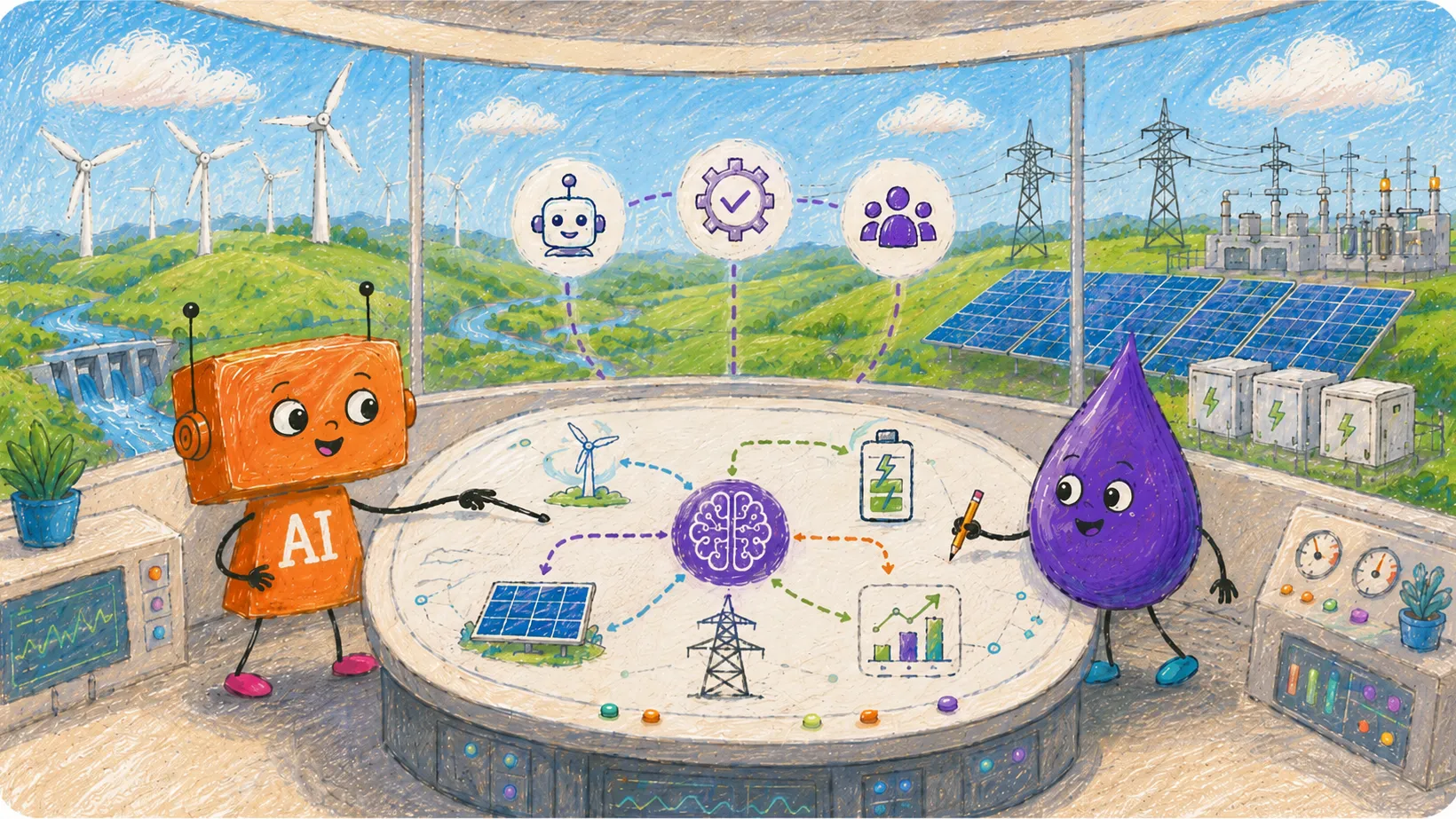
The process-per-agent pattern is the foundation. Each agent is a GenServer, started under a supervisor, addressable by name. Failures are local. Scaling is horizontal. You add nodes to the BEAM cluster and the agents distribute across them without external orchestrators like Redis or Kafka adding latency and operational overhead.
Jido makes this concrete. You define a tool as a Jido.Action module, attach it to a Jido.AI.Agent, and call ask_sync/3 for synchronous reasoning or ask/3 with await/2 for async workflows. The framework handles request tracking, tool dispatch, and result routing. For energy applications, this maps cleanly to agents that query a SCADA API, interpret the result with an LLM, and write a recommendation back to a planning service.
“What really matters for us is Elixir can own this space. It’s basically our time to build with agents and build agents, and Elixir just happens to be the perfect language to do that.” — Chris McCord, creator of the Phoenix framework
One practice worth adopting immediately: create an AGENTS.md file in your project to instruct LLMs on idiomatic Elixir patterns. Frontier models are trained predominantly on JavaScript and Python, so they tend to generate list index-based access and other non-idiomatic patterns. An AGENTS.md file corrects this before the code reaches your codebase.
| Pattern | Elixir tool | EnergyTech use case |
|---|---|---|
| Process-per-agent | GenServer + DynamicSupervisor | One agent per grid asset or sensor stream |
| Reasoning strategies | Jido (ReAct, CoT, Adaptive) | Anomaly detection, demand forecasting |
| LLM routing | ElixirLLM, req_llm | Multi-model calls with fallback and retry |
| Real-time streaming | ClaudeCode + Phoenix LiveView | Live grid dashboards with token streaming |
| Distributed agents | BEAM clustering | Multi-site VPP coordination |
How Elixir compares to Python and other runtimes for agent orchestration
Python leads AI development with an unmatched ecosystem of frameworks and tools. However, its concurrency model struggles with thousands of stateful agents due to the GIL, requiring external queues and databases that add latency and failure points.
Node.js avoids the GIL but faces callback complexity, fragmented tools, and brittle state management at scale. Elixir agents use the actor model with GenServers to isolate failures and enable detailed observability without external queues.
In EnergyTech, the ideal architecture is Elixir orchestrating Python services for heavy tasks. Python handles LLM inference, training, and optimization, while Elixir manages agents, coordinates calls, retries, and system resilience—acting as the conductor, not the orchestra.
EnergyTech-specific challenges and how Elixir addresses them
The energy-AI nexus requires operational reliability beyond model accuracy. Grid stability, real-time streaming, and deterministic control are essential. AI should support, not replace, deterministic systems. Elixir’s fault-tolerant layer manages planning, resilience, and coordination, leaving real-time control to proven systems.
Multi-agent systems show reinforcement learning can boost virtual power plant efficiency by over 30%. Reliable coordination across infrastructure is where Elixir’s process model excels.
Energy security requires careful design. Protocols for agent coordination over unreliable networks, privacy, and protection against strategic agents are essential. Elixir’s process isolation limits damage from compromised agents, and ClaudeCode’s lifecycle hooks ensure program approval and audit trails.
AI orchestration in energy should wrap deterministic controls, not replace them, to ensure grid reliability under uncertainty. — IEA Energy and AI Analysis
Architectural best practices
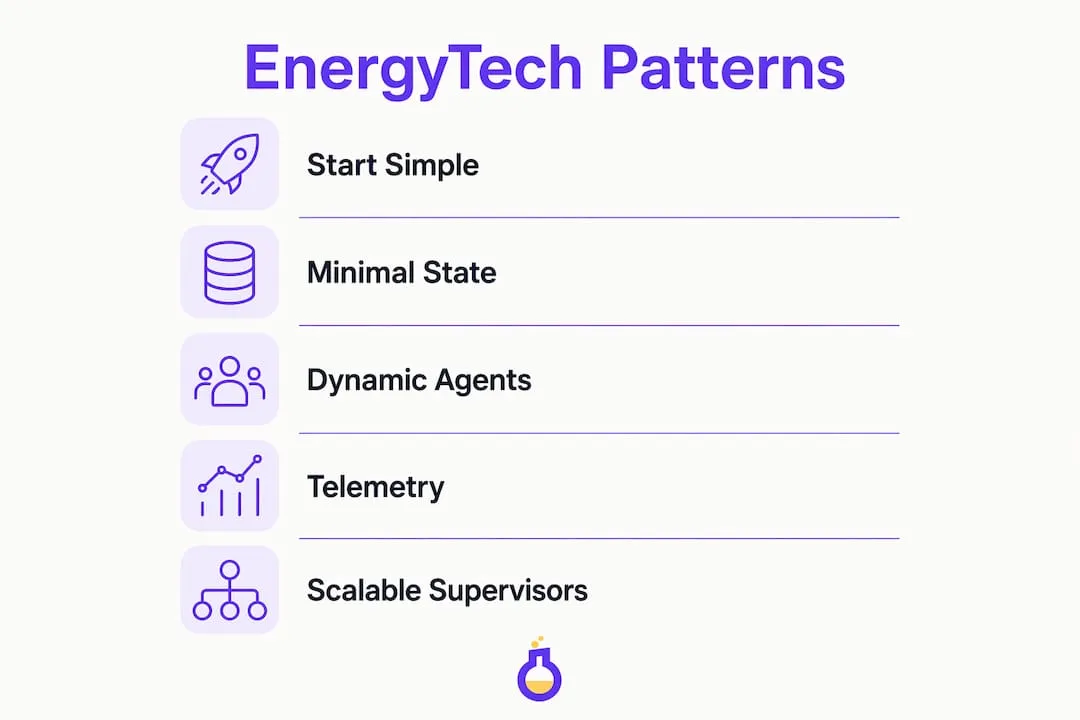
Start with one agent, one tool, one supervisor. The temptation to design a full multi-agent hierarchy before you have a working single agent is where most teams lose weeks. Get a GenServer calling an LLM, handling a failure, and restarting cleanly. Then expand.
Keep agent state minimal. An agent that holds too much in its process heap becomes expensive to restart and hard to inspect. Offload durable state to Ecto and keep the GenServer as a coordination point, not a database. For process orchestration at scale, this separation between coordination state and persistent state is the single most important architectural decision you will make.
Telemetry is not optional. Jido’s Jido.AI.Observe emits stable telemetry event names you can pipe directly into your production dashboards. In energy systems where an agent failure can affect grid operations, knowing which agent failed, why, and how long recovery took is the difference between a minor incident and a reportable event.
Specific use cases where Elixir AI agents deliver in EnergyTech
Virtual power plant coordination is the clearest fit. A VPP aggregates hundreds of distributed energy resources, each needing its own agent to monitor output, receive dispatch signals, and report status. Elixir’s process-per-asset model handles this without external orchestration infrastructure.
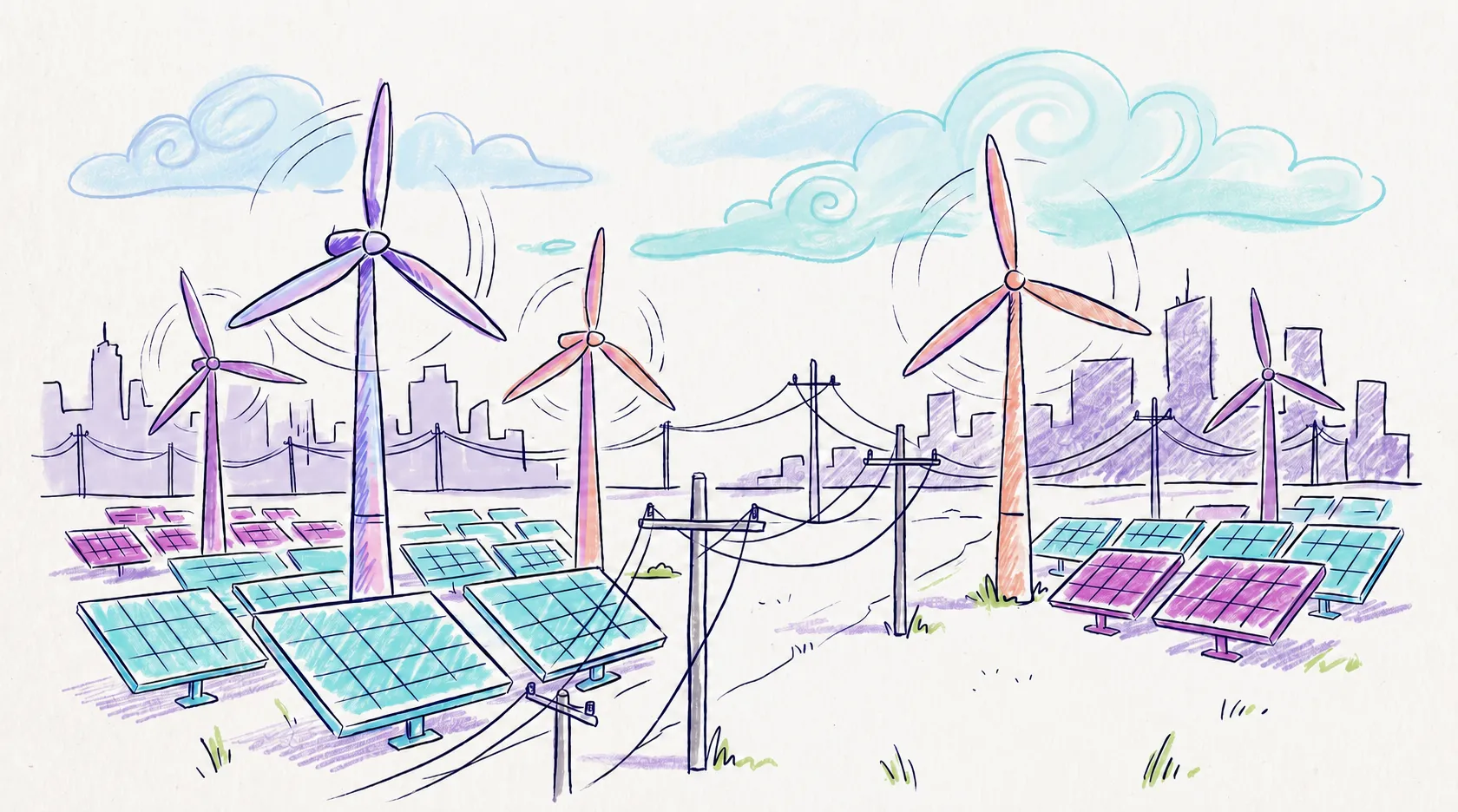
Predictive maintenance for wind turbines and solar arrays benefits from agents that continuously stream sensor data, call anomaly-detection models, and escalate findings to maintenance workflows. The long-lived nature of these agents, running for weeks between maintenance windows, is exactly what BEAM supervision handles well.
Demand response automation requires agents that respond to grid signals within seconds, coordinate with building management systems, and log every decision for regulatory compliance. Elixir’s message-passing model and ClaudeCode’s audit trail hooks address both the speed and the compliance requirements.
Peer-to-peer energy trading platforms need agents representing each prosumer, negotiating in real time based on production forecasts and price signals. The Brooklyn Microgrid project pioneered this model with blockchain-based agents; Elixir’s concurrency model makes the coordination layer far simpler to build and operate.
Elixirator builds the Elixir AI layer your energy platform needs
At Elixirator, we partner with engineering teams who know what they want but need experts who’ve solved the hard parts. If you’re designing an AI layer for an energy platform, we bring hands-on Elixir experience for AI agent architecture, LLM integration, and fault-tolerant systems. We don’t just give you a framework; we build, review, and deliver production-ready code that handles real load. Whether you need a dedicated Elixir team or consulting on your agent design, contact Elixirator to discuss your system’s needs.
Key takeaways
Elixir’s strongest role in EnergyTech AI is orchestrating concurrent, long-running agent workflows around LLMs, data sources, and operational services, not replacing Python for model computation.
| Point | Details |
|---|---|
| BEAM process model | Each AI agent maps to an isolated GenServer, giving you fault tolerance and observability without external queues. |
| VPP performance gains | Reinforcement learning improves virtual power plant operational efficiency by over 30% compared to static rule-based controllers. |
| Elixir vs. Python | Use Python for model inference; use Elixir to coordinate agent lifecycles, retries, and distributed state. |
| Security and compliance | ClaudeCode lifecycle hooks and Jido telemetry provide audit trails essential for regulated energy environments. |
| Elixirator | Elixirator delivers custom Elixir AI agent development and architecture consulting for EnergyTech engineering teams. |